
In Search of Wisdom, Part One
Three Ways Wisdom Helps Us See What Matters Most

Tony Brooks was the first person I was assigned to support in my role as what we now call a Direct Support Professional. Born with cerebral palsy and institutionalized at the age of six, he grew up without natural ways of connecting to his community. Tony longed for purpose, for friendships, and for opportunities to work. My role was to walk alongside him as he pursued those things.
During the winter months, I used to sit with Tony as he put on his coat. He was insistent that he put it on himself and my eagerness to feel important led me to insist that I do it until I realized this was one of the few things he could do on his own. It took him at least 15 minutes. When my hands would reach over to help speed up the process, he would say with vehemence, “I got it!”
The restless feeling I had was like asking myself, what do I gain from sitting next to a man while he put on his coat? My hurried heart and the pressures of New York City made me feel left behind. As I sat there and time seemingly stood still, I thought: someone out there is closing a business deal, someone else is running a 5K. But when I looked at the determination on Tony’s face as he swerved his body, inch by inch, into his coat, I realized I had the most important job in the world.
Joyful is the person who finds wisdom,
the one who gains understanding.
For wisdom is more profitable than silver,
and her wages are better than gold.
Wisdom is more precious than rubies;
nothing you desire can compare with her.
—Proverbs (Mishlei) 3
Three Facets to Wisdom

Who among your friends do you consider wise? What makes them so?
You might think of someone skilled at winning arguments, speaking eloquently, quoting philosophers (all the more impressive when you’ve never heard of them), or making quick, confident decisions.
None of those qualities, on their own, make someone wise.
The ancient wisdom of Proverbs reminds us that wisdom is not mastered so much as sought, found, and received. It’s discovered most clearly in the ordinary, costly choices that shape us: Will I show compassion or turn away? Will I forgive when resentment feels justified? Will I respond with patience, or grasp for control?
Wisdom is rarely discovered where prestige and credentials are waved like badges of authority. At the noisy center, we can hardly hear such questions, though they beg to be heard. It more often shines in the places we overlook—where life is stripped of pretense.
Come with me, and let’s imagine wisdom as a diamond we’ve stumbled upon. We hold it to the light, turn it in three directions, and see how each facet reflects something different, yet all belong to its incomparable worth. As the light of grace catches it, three facets shine:
Seeing Relationships
Seeing Deeper Meaning
Seeing Beyond Utility
The world is so complex that a particular phenomenon is usually only the tip of the iceberg, part of a larger reality of which we may see only one narrow particle, one concrete expression.
— Wolf Wolfensberger
1. Seeing Relationships
The Hebrew word binah means understanding or discernment, the ability to perceive the deeper implications of truth. It goes beyond collecting facts in isolated categories (e.g. math, history, philosophy, science, or religion) and discerns how all realms of life interconnect, how they illuminate one another, and how the light of truth can guide us toward better living.
To follow along in this exploration of wisdom, we’ll have to assume that the universe is not a series of random events, but that there are principles by which the world ordinarily works. Once you begin to see them, you can live with greater stability and foresight.
Think, for example, about gravity. We don’t wake up each morning wondering whether our feet will stay on the floor or if we’ll drift into the doorway. If gravity changed from day to day, life would be exhausting. Morning routines are hard enough without worrying if the ceiling will be today’s floor.
Just as physical laws hold creation together, so too a moral order is woven into the universe. The difference is that while we can measure material realities (though even these exceed our full understanding) we cannot measure the immaterial. Wisdom engages these unseen dimensions, reaching into what cannot be proven yet still shapes the world we live in and the cause-and-effect that unfolds within it.
Do For One is a relationship-building program that brings isolated people into greater community life. We selectively match one person with disabilities (‘Partner’) with another person who enjoys a more socially included life (‘Advocate’).
If wisdom is distinct from intelligence, then it is not limited to the highly educated. It often shines most brightly in the very places we tend to overlook. I first heard this articulated by our friend Jo Massarelli during a Do For One leaders’ retreat, where we were invited to recognize that people with intellectual impairments carry an immense capacity to offer wisdom.
And this is where we begin to see wisdom as a grace, something sought and received.
Wisdom is the ability to bring things together, to see relationships and build relationships.
—Timothy Keller
Seeing Cause and Effect
Wisdom sees how things that look separate are actually connected—our choices and their consequences, what we do now and how it affects the future. It discerns the hidden threads, sees their connections, and shows us how to live in light of them.
If we stop eating, our bodies eventually give in. When pollutants accumulate, the earth suffers. In the same way, societies and cultures decay when truth and justice are neglected. The effects may not surface right away, but they cannot be avoided.
Unlike natural laws, which we rarely question… or do we?…, moral laws are often ignored or redefined. We may break them without seeing the damage right away, or we may dismiss the damage because it falls on someone else. Yet the harm is real, and eventually it surfaces.
The trouble with making wise choices is that they rarely reward us immediately. In fact, wise choices usually cost us something in the short term. Forgiving someone may cost our pride, or telling the truth may cost an opportunity. Wisdom trusts that goodness will come, even if it is not seen right away, or even in our lifetime.
In human services, we are prone to evaluate decisions only by what is immediate, measurable, and material. We count the minutes, calculate outcomes, and choose (and fund!) whatever seems most efficient. But wisdom sees differently. Wisdom sees relationships—not only between people, but between actions and the chain of cause and effect that ripples through the universe.
I experienced this tension while sitting beside Tony as he put on his coat. There was no evidence-based reason why waiting fifteen minutes while he insisted on doing it himself should matter more to either of us than a business deal or a marathon record. Yet in that small, ordinary act, he experienced dignity, and I discovered the joy of touching something true about the meaning of life—deeper than the intellectual mind alone can fathom.
This is wisdom discovered.
My point here, by the way, isn’t that promoting independence is always superior, as some in support services for people with disabilities might argue, but that supporting Tony’s choice reflected freedom and autonomy, which we’re the steps toward interdependence that drew Tony and I closer together in relationship.
Search engines make you more mechanical; library shelves make you less so. Staring at screens makes you easier to handle; listening to people makes you less.
— Timothy Snyder
Losing Sight of Relationships
In contrast, we tend to address life’s issues in fragmented boxes as if they were not deeply intertwined. This came into focus for me when I attended the Moral Coherency workshop led by Dr. Wolf Wolfensberger’s Training Institute at Syracuse University.
In human services, a person’s needs are typically divided into categories—housing, employment, recreation, therapy—each handled by different departments that rarely (even prohibited to!) communicate with each other. The result is services that may address a surface-level need (or an irrelevant need), but often miss the integrated realities of a person’s life.
I saw this in the services Tony relied on and especially during his life-plan meetings (then called an Individualized Service Plan). At that point I was no longer paid, but chose to remain in his life as an honorary family member and friend. At one of those meetings, Tony said, “I want to keep my mind occupied.” His recreational therapist quickly jumped in with a canned answer, suggesting that the solution was simply to keep him busier with activities inside the agency’s special needs programs.
Click here to learn more about Training Institute Workshops or contact me at andrew@doforone.org to learn more.
But if we zoom out from the “special needs” box, we remember that all humans are made to create and to contribute to our communities. For Tony, this meant pursuing meaningful work. That pursuit moved him beyond idle time and over-reliance on special-needs programming, to volunteering at the local library, and eventually to a paid job at Planet Hollywood in Times Square.
If fragmentation blinds us by pulling life apart into disconnected “specialized” pieces, the hive mind, as some call it, blinds us in the opposite way—by collapsing one set of perspectives, cutting them off from other worthy considerations, and embracing them as if they were the whole truth. Full stop. And uncritically.
Algorithms in our social media feeds exploit our existing interests and emotions. Over time, our thinking becomes predictable not because we have weighed every angle and reached the same conclusion, but because our minds have been trained to see and respond in the same narrow ways.
The same can happen in human services. Professionals read the same reports, attend the same conferences, and adopt the same language. New technologies and “best practices” are embraced quickly, often without evaluation. Gradually, assumptions harden, innovation slows, and everyone begins offering the same predictable “solutions.”
When the “right” phrases and technologies become badges of being in the know—and the “wrong” ones mark someone as ignorant or out of touch—we risk alienating well-meaning people who might otherwise step forward to become allies. Ironically, this re-creates the very exclusion that disability movements are striving to overcome.
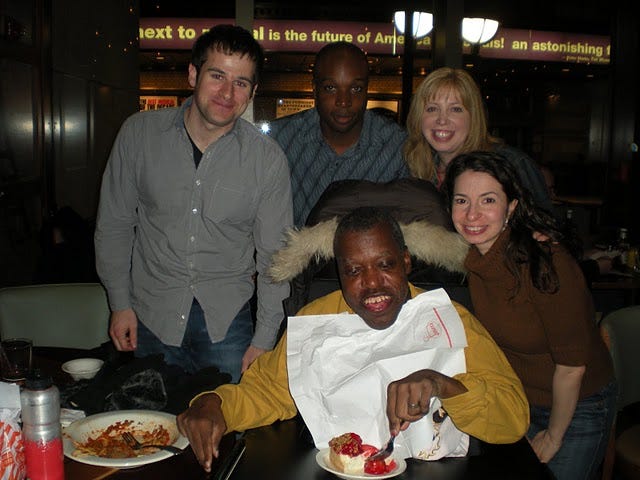
Celebrating Tony’s birthday at Junior’s, Times Square, 2008
What Matters Most
Because wisdom works differently from the hive mind or the fragmented mind, it rarely gives predictable answers—and it’s unlikely to go viral. It does so precisely because it has the ability to see relationships across seemingly disparate realms of reality.
When asked a political question, wisdom replies with a philosophical reflection. When asked a theological question, we are shown connections through an agricultural metaphor. When pressed for an opinion, we hear a story that deepens the mystery. Personal dilemmas are not met with quick prescriptions but with probing questions.
You are more likely to find wisdom looking out the window than staring at a screen. Taking a walk rather than scrolling TikTok. Talking with a neighbor than consulting ChatGPT.
When we go to the places where wisdom is found, it is not information we gain—or if we do, it matters less. What becomes most important, is that we ourselves are being changed.
Tony listened without the usual socially acceptable script and had a way of cutting through conversations to what really mattered. When friends talked about workplace frustrations—office politics, overbearing bosses, never-ending projects—he wouldn’t nod along or pile on with fragmented or hive-mind responses. Instead, he’d tilt his head, pause for a moment, and say, “At least you have something to do.”
At first, a reply like that could feel dismissive of people’s struggles. And maybe it was!? Tony could be cranky at times. But no one took it that way. He reminded us that work itself—having something meaningful to put our hands to—is a gift. What we saw as problems to complain about, he saw as signs of purpose.
Coming from someone who had known long stretches (years, decades!) of boredom, exclusion, and days without purpose, Tony’s words stopped us in our tracks. The conversation shifted. Complaints gave way to gratitude—a perspective no algorithm could have predicted, and only wisdom could have truly made sense of.
This is the first turn of the diamond: wisdom’s ability to see relationships. Stay tuned for Part 2.
See related posts:


"You are more likely to find wisdom looking out the window than staring at a screen."
Thank you for this.