
In Search of Wisdom, Part Two
Three Ways Wisdom Helps Us See What Matters Most

This is the second and final post in the Search of Wisdom series. [Read part one here.]
Come with me, and let’s imagine wisdom as a diamond we’ve stumbled upon. We hold it to the light, turn it in three directions, and see how each facet reflects something different, yet all belong to its incomparable worth. As the light of grace catches it, three facets shine:
Part two:
Seeing RelationshipsSeeing Deeper Meaning
Seeing Beyond Utility

2. Seeing Deeper Meaning
This facet is expressed in the Greek word phronesis, which means the ability to discern what is worth doing and to know how to act accordingly.
This kind of wisdom isn’t gained by collecting secondhand knowledge from books, podcasts, or streaming shows. It’s formed in the unexpected, unplanned moments of life, through interruptions that unsettle our preconceived, perhaps romanticized, notions of how life should work and invite us to see beneath the surface.
We grow in wisdom by doing things that reveal just how much we need it: stepping into the real world, meeting people, opening our hearts, going places, and taking risks. Wisdom doesn’t grow if we choose a more passive life that demands little to no wisdom.
We are seasoned with wisdom by running headlong into walls of needed change, feeling the perplexity, and seeing firsthand just how much we need it.
Different from Ethics, Principles, and Rules
Ethics can tell you it’s good to help someone out of poverty. Wisdom helps you discern how to help in a way that improves their life in a sustainable way, rather than fostering dependency.
Principles give us guideposts. Wisdom teaches us how to navigate the winding, uneven road between them.
Moral rules can tell us that murder is wrong. Wisdom is what we need when we have been wronged and the pull of anger clouds our judgment.
Wisdom asks the questions that ethics, principles, and rules can’t fully answer: Should I take this new job? Is this decision worth the risk? How do I speak the truth in a way that doesn’t destroy trust?
“Give me neither poverty nor riches, but give me only my daily bread. Otherwise, I may have too much and disown you and say, ‘Who is the Lord?’ Or I may become poor and steal, and so dishonor the name of my God.”
—Proverbs (Mishlei) 30)
The Edge of the Inside
How do we live wisely in a world swept away by relentless winds of evil, folly, and disharmony? Do we give in and let ourselves be blown and tossed around like autumn leaves in a restless wind? Winter comes quickly, and we all know what happens to those autumn leaves.
Or do we choose to hold steady, staying rooted in deeper meaning? If do we stay committed, we will soon realize that wisdom carries a tension that never fully resolves, so how do we manage that tension?
This is where it gets especially tricky to understand, let alone put into words so indulge me for a moment as I try:
Richard Rohr, a Franciscan priest, coined the term edge of the inside to describe prophets. At the noisy center, we are easily swept into folly; but far on the outside, we risk cynicism and a detached sense of superiority.
The edge of the inside can feel uncomfortable, humbling, even lonely, yet it offers a sober, transformative perspective. Those who walk this edge remain close enough to the heart of a community or tradition to stay deeply rooted in love and relationship, yet far enough to see its blind spots and resist its illusions.
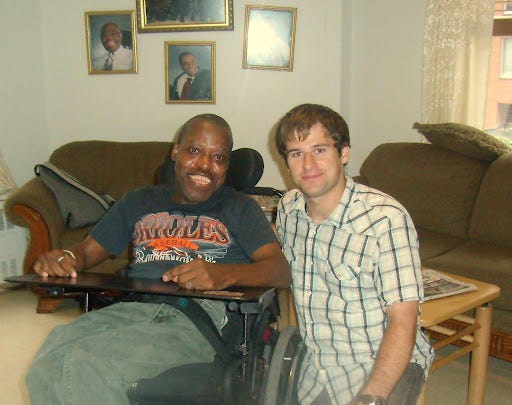
Tony and me at his group home New York, NY around 2005
When I started inviting Tony to church, I was keenly aware of the many subtle, and not so subtle, devaluing mindsets people with disabilities often face. Yet I also sensed the immense potential for this to be Tony’s community as much as it was mine.
I felt the tension of the question: Are we on the inside or the outside of this community?
Had we withdrawn and stayed on the outside—keeping to ourselves, avoiding conversation—it would have been easy to grow proud. I could have told myself that church was “too shallow” for people like us, or started believing that no one else could possibly understand him the way I did.
Had we gone all the way in without questioning the subtle ways others diminished his worth, it would have been just as easy to self-congratulate for achieving inclusion while turning him into a token of charity, quietly conforming to the very assumptions that held him back.
But instead, it was about discovering a completely unique path altogether of walking side by side, drawing close enough to the community, giving it a fair shot to see who would truly welcome us.
Wisdom is not so much a matter of mastering a bunch of rules. It's a love affair with wisdom.
- Tim Keller
3. Seeing Beyond Utility
When I first met Tony as a Direct Support Professional, I was certain I could “help.” The CDs on Tony’s bed were never broken intentionally. They just lived with him there, slept on, always within reach, like his spare batteries and other necessities. Out of habit, I reached for the clutter. But this wasn’t a mess to him. It was carefully arranged so he didn’t have to rely on staff every few hours to get him what he needed.
I thought I knew what he needed: a cleaner room, a better routine, a bit of spiritual encouragement to “turn things around.” I was sincere, but I’m embarrassed now at how much cheap, if not hurtful, advice I must have given. I was too sure of my own understanding, too confident I could connect all the pieces of his life.
In a way, I was leaning on a misguided self-made version of the first two facets of wisdom. Wisdom first sees how everything is connected (binah), and second knows how to respond in real time (phronesis). But without the third facet, we can forget that wisdom is a grace.
This third facet may feel like it contradicts the others, yet it’s the facet that, when the light hits just right, it makes the whole diamond shimmer.
This third facet reminds us that wisdom isn’t a destination we reach and defend. It’s a lifelong pursuit of truth that keeps us curious and reverent. The Judeo-Christian tradition calls this posture yir’ah—“the fear of the Lord,” the beginning of wisdom (Proverbs 9:10).
Slowly, I stopped trying to impose order in Tony’s life and just started sitting with him, watching Tyra Banks reruns and listening for faint signals of trust. Over time, our worlds aligned just enough for us to move forward together.
Ultimately, this “love affair” with wisdom, as Tim Keller put it, frees us to love rather than compete over who is right and who is wrong. We are more likely to walk in love when truth is not a trophy to claim but a horizon we journey toward—a mystery glimpsed yet never fully grasped in this life.
What Matters Most
Wisdom is not found in quick solutions but in the slow work of healing—a healing that is layered and interwoven through people, communities, and the traditions that hold us together. It’s a relentless pursuit in love, a willingness to be reshaped, a desire not to become a know it all but to live in harmony with what is true and good.
To seek wisdom is to loosen our grip on certainty and control, letting go of our many misconceptions about the world so that we can be taught, surprised, and changed.
And now we see why Proverbs gives Wisdom a name, a voice, a face. She walks the streets, crying out to those who will listen. She lingers at the margins, in places we would rather avoid. She invites us to remain there long enough to see life from that vantage point, and it is in those hidden places that she does her deepest work—shaping us into people of grace, courage, and love.
Ultimately, wisdom is both a gift and a calling. She is given to us by grace and received through a posture of humility. Her brilliance shines brightest when reflected through lives willing to be transformed.
Nothing in this world is more precious.
See related posts:
In Search of Wisdom, Part One

Tony Brooks was the first person I was assigned to support in my role as what we now call a Direct Support Professional. Born with cerebral palsy and institutionalized at the age of six, he grew up without natural ways of connecting to his community. Tony longed for purpose, for friendships, and for opportunities to work. My role was to walk alongside h…
